The End of Greenwashing
- Gergely Kovács
- Jun 10
- 4 min read

Updated: Jun 17
Why John Elkington—the architect of the Triple Bottom Line—stepped back from his own framework, and why the future of corporate sustainability now points beyond compliance toward regenerative business.
For years, corporate sustainability was built around reporting, checklists, and incremental improvement. However, this compliance-centric model has visibly reached its limits and is now breaking down. Sustainability consultants are often criticized for relying on overly abstract principles that are difficult to apply in practice. At Greenbors Consulting, we take a completely different stance: we believe the market does not need empty slogans, but rock-solid realism.

That is precisely why it is time to address the developments that are fundamentally challenging everything we thought we knew about corporate green operations. The starting point for this debate stems from fresh international research—and an extraordinary intellectual reversal by John Elkington, one of the field’s founding thinkers, a shift that was a prominent topic at the recent HVG Impact Talks conference.
What these signals clearly indicate is that the next chapter of sustainability will no longer be about merely operating to be "less bad" or doing slightly less harm. Instead, it demands a systemic, regenerative paradigm shift—redesigning business so that it can actively help repair the systems on which it depends.

Why the old sustainability model ran out of road
In 1994, John Elkington introduced one of the most influential ideas in modern corporate responsibility: the Triple Bottom Line—Profit, People, Planet. The concept was never meant to be a decorative scorecard. It was designed as a challenge to the dominant logic of capitalism, asking businesses to weigh social and ecological outcomes as seriously as financial performance.
But by 2018 Elkington had reached an unsettling conclusion. In a rare move for a founding thinker, he publicly “recalled” his own framework. The problem was not the ambition behind the idea. The problem was what the market had done with it. Instead of using the Triple Bottom Line to transform business models, many companies turned it into a branding device, a reporting template or a reputational shield.
That slippage matters. Once sustainability becomes a communications layer rather than an operating principle, the centre of gravity remains unchanged: profit still overrides everything else, and the best many firms can claim is that they are marginally less harmful than before. In the face of climate disruption, resource stress and social fragmentation, that is no longer a serious answer.
“The era of sustainability is over. We have arrived at the era of regime change.”
Three moments that changed the conversation

What the new research is really saying
The Sustainability at a Crossroads (2025) report points to a major new signal, described there as a global report produced jointly by ERM, GlobeScan and Volans, with input from 844 sustainability experts across 72 countries. The tone is not mildly corrective. It is diagnostic—and severe.
The survey suggests that conventional sustainability practice has reached its limits. Experts are no longer asking for better messaging or cleaner reporting architecture; they are calling for an overhaul. The credibility gap is especially damaging. If the private sector speaks the language of sustainability while leaving core systems intact, trust erodes—and with it the legitimacy of the entire agenda.
Equally telling is the report’s wider mood: confidence in the global framework has weakened. The idea that the existing pace of action will be enough to deliver the 2030 Sustainable Development Goals or preserve the Paris Agreement’s 1.5°C pathway now appears deeply uncertain. In other words, the problem is not simply underperformance. It is structural inadequacy.
Key numbers at a glance

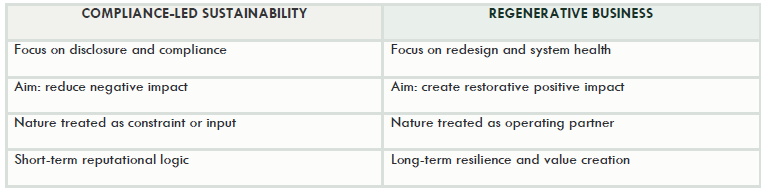
From “less bad” to regenerative value creation
If the compliance era is ending, what replaces it? In Elkington’s view, the answer is regeneration. This is a decisive conceptual shift. A regenerative company does not stop at reducing waste, emissions or social harm. It asks how its activities can help restore damaged ecosystems, strengthen communities and make the wider operating environment more resilient over time.
That demands more than incremental efficiency. Linear business models have to give way to circular design, extractive relationships have to be rethought, and nature can no longer be treated as a passive warehouse of raw materials. In this frame, business is not an isolated profit engine sitting on top of society and the environment. It is embedded in both—and accountable to both.
The article also points to a market mechanism for this transition: the rise of “Green Swans”, meaning breakthrough technologies and innovations capable of changing the economic equation at speed. Renewable energy cost declines, alternative proteins and AI-assisted carbon removal are presented as examples of how radical change can move from ethical aspiration to commercial reality.
Old playbook vs. regenerative playbook
What this means for decision-makers
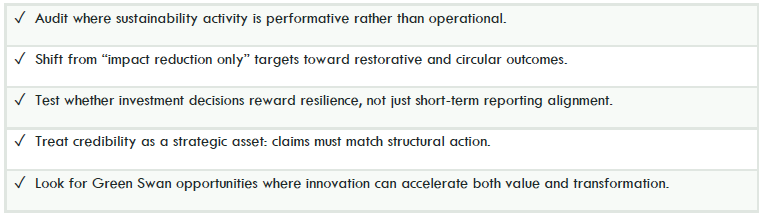
The message for business leaders is not to abandon sustainability, but to abandon the illusion that reporting alone is strategy. The next competitive frontier lies in whether companies can move beyond mandatory minimums and embed environmental and social value into the economics of assets, portfolios, and operations.
For firms in the built environment—where energy use, embodied carbon, resilience, and long-term asset quality are tightly linked—the implication is particularly sharp. Future value will be measured not only by whether a building meets current disclosure rules, but by whether it is materially better for occupants, communities, natural systems, and long-range portfolio durability.
Driving the Paradigm Shift
At Greenbors, we do not just talk about this paradigm shift; we actively drive it. We are firmly convinced that in today’s green real estate economy, merely meeting mandatory minimums or checking formal compliance boxes is no longer enough. Real, tangible impact must replace superficial solutions and cosmetic reporting.
That is why we passionately advocate for raising the bar in market practices. We encourage our clients to never settle for baseline expectations, but to aggressively pursue the highest tiers of sustainability certifications. Ultimately, the true value of a building, an investment, or an entire portfolio no longer rests on mere compliance, but on its long-term capacity to actively protect the environment and ensure genuine future-proofing.
Therefore, the crucial question is no longer whether a company meets current EU green reporting mandates. The real question is this: Do we have the courage to look beyond regulatory minimums, build a strategy that creates measurable value for both society and nature—and treat that ambition as core business, not corporate decoration?
A practical boardroom checklist


Comments