Greenbors Business Breakfast: Climate Adaptation in the Real Estate Sector

From Physical Climate Risks to Concrete Solutions
The timeliness of climate adaptation is highlighted by the fact that Gábor Szarvas, Managing Director of Greenbors Consulting, returned from London just the day before the event, where temperatures around 27 °C were still being measured in late September and early October. However, the difference was not only striking on the thermometer: under the shade of the trees, the temperature dropped to around 18 °C.
It is particularly telling that the importance of climate resilience is receiving increasing emphasis within the international sustainable building sector. At the 2026 BREEAM Awards—in which Gábor participated—projects addressing climate risks and long-term resilience were recognized in a dedicated Climate Resilience Excellence category. This year’s award was won by the Wonderwoods office and residential project in Utrecht, Netherlands.

Gábor brought home more than just the atmosphere of the BREEAM Awards from London: Sustainabot, co-developed by Greenbors, also took first prize in the Digital Sustainability Innovation category.

Climate Risk Is No Longer a Theoretical Question
The professional portion of the breakfast was opened by Gábor Szarvas, who pointed out that the extreme weather events of last summer clearly demonstrated that climate adaptation is no longer simply an environmental or ESG issue.
Today, climate risk is an exercise in economic, social, and real estate risk management.
At the building level, this translates into very concrete challenges. Warmer summers increase cooling demand and operational costs, while extreme temperatures accelerate the aging of certain facade, roofing, and sealing materials. Intense rainfall poses a particular threat to underground garages, basements, and mechanical plant rooms, while Hungary simultaneously faces the twin challenges of water scarcity and sudden cloudbursts.
The experiences shared by participants supported this reality. When asked to what extent they already feel the direct impacts of climate risks today, 53% noted that manageable problems are appearing, albeit sporadically, while for 41%, climate risk already represents a serious operational and financial challenge. Only a small percentage viewed the topic primarily as a theoretical or reporting matter.

Responses to a second poll clearly showed that extreme heatwaves and prolonged droughts pose the greatest threats today, highlighted by 42% and 35% of respondents, respectively. Flash floods and sudden precipitation events received 19%, while storms and wind gusts accounted for 4%.

A kérdés tehát már nem az, hogy szükség van-e alkalmazkodásra, hanem az, hogy hogyan válik az általános kockázatfelismerés konkrét, végrehajtható intézkedésekké.
Adaptation Is Not a One-Off Project, But Ongoing Management
András Bálinger, Senior Consultant at Greenbors Consulting, illustrated this through the concrete case study of the ALLEE Shopping Centre.
The first step in the climate adaptation process is not selecting a specific technology, but understanding the climate risks facing a given building, how these might impact it, and how vulnerable it is to them. In ALLEE's case, an overall climate exposure assessment was translated into a building-specific risk profile, forming the baseline for a prioritized adaptation action plan.
This action plan is not a simple checklist. It prioritizes interventions based on risk severity, expected outcome, technical and financial feasibility, operational requirements, and scheduling. The goal is to provide actionable, measurable, and phased responses to real-world risks.
The ALLEE Example: Building on Existing Systems
A key takeaway is that climate adaptation does not necessarily require entirely new infrastructure. In many cases, existing buildings and their systems contain untapped adaptation opportunities.
At ALLEE, for instance, groundwater must be continually pumped out to ensure the safe operation of the underground garage. This created an opportunity to explore whether—after appropriate treatment—this water could supply the cooling towers. This approach simultaneously reduces reliance on the municipal water network and enhances the security of the cooling system during critical summer peaks.

Similarly, overheating can be mitigated by combining multiple measures: external shading, solar control films, green spaces, and rooftop solar panels all contribute to reducing heat load and peak cooling demands.
Dávid Tuska, Technical Manager at ALLEE, highlighted that:
Alongside technical solutions, owner commitment plays a decisive role. Thanks to measures previously implemented at ALLEE, the impact of this summer's increased load and energy crisis was significantly diminished.
In short, adaptation is often not a future "climate investment," but the result of earlier decisions that now manifest in a building’s operational resilience. Data is becoming increasingly vital to this process: ALLEE's existing BMS infrastructure allows for continuous monitoring of energy and water consumption, comfort levels, and performance—ensuring climate adaptation remains a live operational tool rather than a static document.
How Does an Adaptation Measure Become a Viable Business Investment?
This was one of the central questions revisited throughout the event.

When participants were asked about the primary barrier to implementing blue-green infrastructure (such as rain gardens or green roofs), the answer was clear: 54% cited the difficulty of quantifying payback and financial return. Space constraints, technical limitations, and a lack of expertise in design, execution, and operation were each cited by 13% of respondents.
This marks a crucial transition from technical solutions toward financing. According to Dóra Szemerédi, Head of the ESG Working Group at the Hungarian Shopping Center Association:
Green financing options are already available in Hungary today where 'the math works out' for these investments.
The challenge increasingly lies in properly identifying, quantifying, and translating adaptation investments into a business language understood by owners, operators, and financiers alike.
Nature-Based Solutions Make Properties More Resilient, Not Just Greener
In the following presentation, Gábor Szőllősi, Managing Director of Gardenfutura, approached the topic from another angle: how can the surrounding environment itself become an integral part of a building's climate adaptation system?
The Sponge City model is built on establishing a new balance between nature (rainwater, vegetation, soil) and the built environment. Rather than draining stormwater away as quickly as possible, the goal is to retain it locally and utilize it through vegetation where feasible. In return, plants provide cooling shade and create a restorative environment for occupants. Green, blue, and gray infrastructure thus function as mutually reinforcing systems.
Furthermore, these solutions are not restricted to new developments.
Technologies presented by Gardenfutura include modular, retrofittable green roofs. Data shown during the presentation demonstrated that these can reduce cooling energy consumption by 25–75%, lighten the load on municipal drainage networks, and up to triple the lifespan of a roof structure.

A similar logic underpins the Stockholm Tree Planting System, which enables large, mature trees to thrive within paved urban settings. According to the presented data, a single tree can retain up to 5,000 liters of water and transpire roughly 400 liters daily, providing shading and mitigating environmental heat stress.
A central message of the Sponge City concept is that vegetation is not merely an aesthetic choice or a "green space obligation." Properly planned, it serves as a powerful tool for energy efficiency, water management, and climate adaptation.
Trees Are Assets, Not Just Green Cover
The discussion also explored how the value of nature-based solutions and green environments can directly translate into the economic value of real estate.
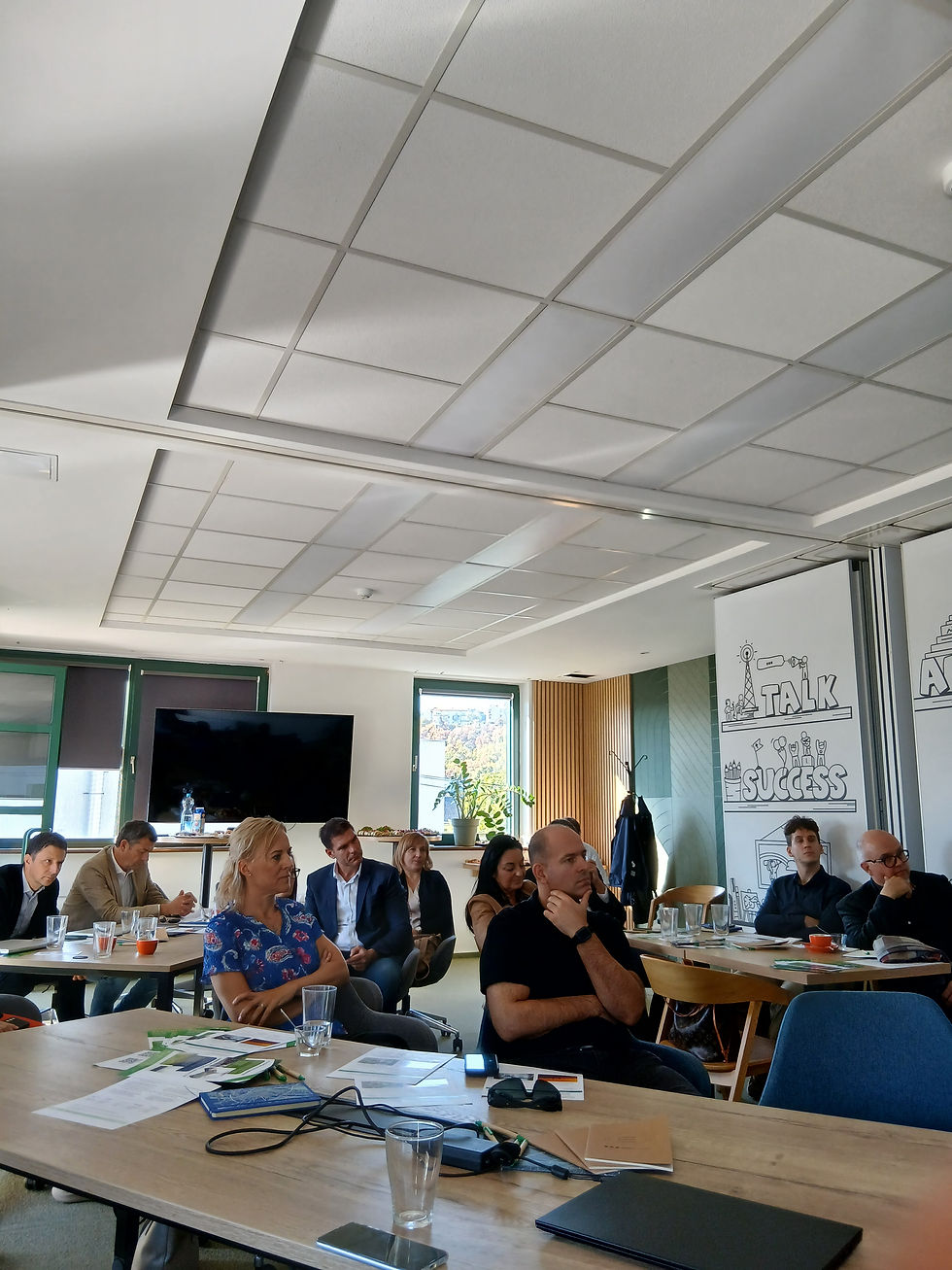
According to Gábor Szőllősi, most Sponge City projects to date have been municipal initiatives, while market-driven developer projects remain fewer in number. However, as buyer and tenant preferences evolve, the lack of a green environment is turning into a direct business disadvantage.
A commercial property with a hot, unshaded parking lot and a bleak environment is simply less attractive to customers than a competitor operating in a pleasant, green setting.
This brings the intrinsic value of trees into sharp focus. A tree is an asset in itself, but a large, mature tree represents even greater value, as its ecosystem services scale with the size of its canopy. According to data from FŐKERT (Budapest Public Forestry), the average age of managed trees in Budapest is currently around 25 years. However, trees reach peak ecosystem performance—such as shading, evapotranspiration, carbon sequestration, and dust retention—at 30 to 40 years of age.
Replacing mature trees with young saplings does not yield immediate equivalence: canopy volume and leaf surface area increase dramatically as a tree ages. As FŐKERT highlighted, 30- to 40-year-old trees offer the maximum shading surface and canopy mass required to cool urban areas, manage rainfall, and purify the air.
Mindsets are gradually shifting: cutting down a mature tree is no longer seen as removing a simple landscape element, but as losing a valuable ecological asset built over decades.
This perspective is gaining ground within EU and national regulatory frameworks. Under the EU Nature Restoration Regulation that entered into force in 2024, member states must prepare national restoration plans in 2026, aimed at preserving and expanding urban green spaces and tree canopy cover over the long term.
In Hungary, green space certification rules have spurred new methodologies aimed at quantifying both the ecological and monetary value of vegetation and mature trees.
Financing Is Already Integral to Climate Adaptation Thinking
Toward the end of the event, the focus returned to financing. Participants were polled on whether they already see climate adaptation influencing financing terms.

For 60% of respondents, climate adaptation is already a concrete pricing and lending consideration for banks and investors—particularly through green loans or EU Taxonomy alignment. An additional 40% noted that while adaptation is evaluated in reporting, it does not yet directly impact borrowing costs.
This illustrates a market in transition. Climate risk is factored into decision-making, but financial valuation of physical building resilience is still evolving. This makes it vital for climate adaptation to move beyond isolated sustainability projects and become embedded in long-term business and operational strategies.
The good news is that established green building certifications (such as BREEAM and DGNB) place significant emphasis on climate adaptation; projects aiming for top-tier ratings in these systems must complete formal risk assessments. Furthermore, a key development in Hungary is that since January 2026, the Central Bank of Hungary’s (MNB) preferential green capital requirement program has incorporated climate adaptation criteria, allowing compliant projects to access subsidized financing.
Climate adaptation criteria are also integrated into the technical standards of the EU Taxonomy for real estate. In Hungary, certification for compliant buildings is conducted by the HuGBC through accredited EU Taxonomy experts, including those from Greenbors Consulting.
Climate Adaptation Is About Preserving Asset Value
A shared takeaway from the business breakfast was that climate adaptation is not about a single technology, green roof, or tree-planting program.

The right approach begins with identifying building-specific risks and vulnerability assessments, followed by measures that are technically, financially, and operationally feasible. The ALLEE case study demonstrated that the process does not end there: continuous monitoring, clear KPIs, and regular reviews ensure adaptation measures dynamically respond to changing conditions.
Meanwhile, the Sponge City model illustrated how a building's surroundings actively contribute to resilience: trees, green roofs, rain gardens, and permeable paving are not just "green" features—they are functional tools for managing thermal loads, stormwater, and operational expenses.
As summarized at the event, the true value of climate adaptation emerges when risks are turned into concrete decisions, decisions into measurable actions, and actions into resilient, value-retaining real estate over the long term.
Greenbors Consulting: From Risk Assessment to Adaptation Action Plans
Greenbors Consulting provides expert support for real estate owners and operators—from identifying physical climate risks and vulnerabilities to defining adaptation measures and verifying EU Taxonomy and BREEAM compliance. Our mission is to ensure climate risk assessments do not remain static reports, but are transformed into prioritized, measurable actions that comply with international standards and local conditions alike—supporting the operational resilience, performance, and long-term asset value of your real estate portfolio.


Comments